Book Detail:
Language: English
Pages: 127
Author: TNAU
Price: Free
All TNAU Notes
You can also downlod this files from EAgri portal as well ICAR ECourses.

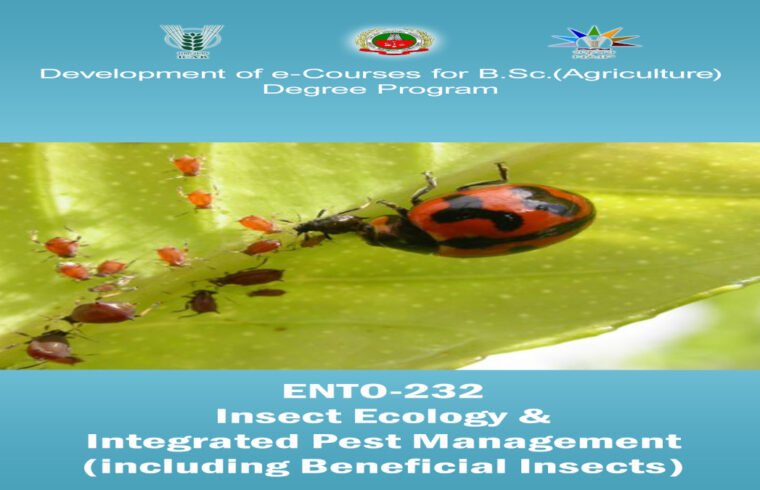
Course Outline: Insect Ecology & IPM including beneficial insects (ENTO – 232)
- Principles of applied entomology – economic classification of insects.
- Bee species – comparison – castes of bees – bee behaviour and bee dance.
- Apiary management practices – bee pasturage – foraging – seasonal variations.
- Role of bees in cross pollination – their exploitation – case studies with selected crops.
- Bee products – their properties and uses.
- Effect of agricultural inputs on bee activity – pesticide poisoning.
- Role of pollinators, weed killers and other beneficial insects.
- Management of household pests, vectors of human diseases and pests of cattle and poultry.
- Insect ecology – definition – balance of life in nature – reproductive potential and environmental resistance.
- Population dynamics – role of biotic factors – competition – parasitoids and predatots.
- Life table – Interspecific and intraspecific relationship.
- Abiotic factors – physical, nutritional and host plant associated factors on insect population. Bioresources in ecosystems.
- Pests – definition, categories and causes for outbreak of pests. Losses caused by pests.
- Pest monitoring – pest surveillance and forecasting – objectives, survey, sampling techniques and decision making. Economic Threshold Level and Economic Injury Level.
- Factors influencing Economic Injury Level and Economic Threshold Level.
- Pest Management – definition – need – objectives, requirements for successful pest management programme. Components of pest management.
- Cultural methods – definition – characteristics, requisites – farm level practices and community level practices, advantages and disadvantages.
- Physical methods – definition – use of heat, moisture, light, lectromagnetic energy and sound energy – Mechanical methods – definition – mechanical destruction and exclusion – merits and demerits.
- Mid semester examination.
- Legal methods – definition – pest introductions – quarantine – phytosanitary certificate – pest legislation.
- Host plant resistance – definition – types and mechanisms, ecological and genetic resistance.
- Host-plant resistance in pest management – compatibility with other pest management practices – merits and demerits.
- Biological control – definition – history and development – classical examples – factors governing biological control.
- Predators and parasitoids of agricultural importance – role in pest management.
- Chemical control – definition – history of insecticide development – toxicity parameters – ideal qualities of an insecticide.
- Classification of insecticides based on mode of entry, mode of action and chemical nature.
- Insecticides Act 1968 – insecticide residues and waiting periods. Role of pesticides in pest management.
- Semiochemicals – definition – intraspecific semiochemicals – allomone, kairomone, synomone and apneumone.
- Interspecific semiochemicals – pheromone, sex pheromone, alarm and trail marking pheromone. Pheromones in Integrated Pest Management.
- Sterility methods – definition – principles – methods – requirements and limitaitons.
- Insect growth regulators – moult inhibitors – Juvenile Hormone mimics – mode of action and uses. Insect anti feed ants and repellents – mode of action, groups and uses.
- Pesticide application technology – principles and methods.
- Pesticide compatibility, safety and hazards – antidotes – safe handling – impact of pesticides on agro ecosystems. Impact of global warming on pests.
- Integrated Pest Management – history, principles and strategies – relationship between different components and economics.
- Integrated Pest Management: Issues and options. Eco friendly Integrated Pest Management – Indigenous/traditional technologies in Integrated Pest Management.
- Specific Integrated Pest Management practices for rice and cotton. Biotechnology in pest management.