Book Detail:
Language: English
Pages: 182
Author: TNAU
Price: Free
All TNAU Notes
You can also downlod this files from EAgri portal as well ICAR ECourses.

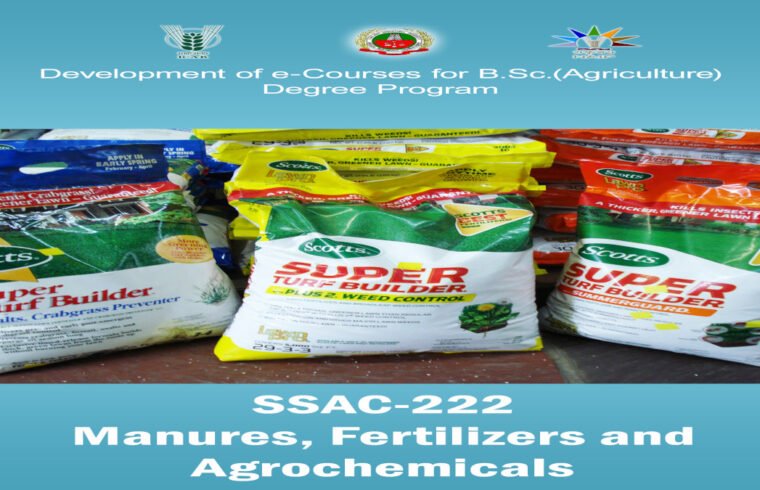
Course Outline: Manures, Fertilizers and Agrochemicals (SSAC – 222)
- Manures – types, composition and value – sources
- Green manures-Oil cakes-Sewage sludge-Biogas plant slurry-Plant and animal refuges
- Composting of organic wastes – composting technologies
- Classification of fertilizers – N, P and K fertilizers
- Nitrogenous fertilizers – sources – fundamental processes involved in manufacturing procedures for ammonia, sulphuric acid, nitric acid and phosphoric acid
- Manufacturing of ammonium sulphate, ammonium nitrate and ammonium chloride
- Manufacturing of urea
- Slow release N fertilizers – chemically modified forms – urea-formaldehyde, IBDU, CDU.
- Controlled release fertilizers and reaction in soil – nitrification inhibitors – criteria and advantages
- P fertilizers – rock phosphate – bone meal – basic slag
- Single and triple super phosphates – thermosphosphates – method of manufacturing
- Potassic fertilizers –manufacturing of KCl, K2SO4 and schoenite
- Secondary and micronutrient fertilizers- Manufacturing Zinc sulphate, and ferrous sulphate
- Complex fertilizers – manufacturing ammonium phosphates – nitro phosphates and NPK complexes
- Mixed fertilizers – sources – preparations- their compatibility – advantages
- Amendments-calcium sulphate and calcium carbonate
- Midsemester examination
- Biofertilizers- symbiotic and non symbiotic and their advantage
- Impact of fertilizers on the environment
- Fertilizer control order and Fertilizer storage
- Organic chemistry as prelude to agrochemicals- -Diverse type of agrochemicals
- Pesticides formulations – sprays – emulsion concentrates- water miscible liquids-dusts – wettable powders and flowables – manufacture, characteristics and uses.
- Pesticide formulation – granules, fumigants and aerosols – Manufacture – Characteristics and use. Insecticide classification – Organochlorines – Mode of action – lindane, endosulfan – Characteristics and use.
- Organophosphates – characteristics, preparation and use of monocrotophos, phosphamidan, and chlorpyriphos. Phorate, phosalone, dimethoate and quinalphos.
- Carbamates – characteristics, preparation and use of Carbaryl, carbofuran, carbosulfan and aldicarb
- Botanicals – characteristics, preparation and use of neem products, nicotine and pyrethrum.
- Characteristics, preparation and use of synthetic pyrethroids – Fenvalerate and Cypermethrin.
- Herbicides – Mode of action -Classification of organic herbicides – Characteristics – Use of 2, 4-D. , Butachlor, Glyphosate, Atrazine and Benthiocarp
- Fungicides – Classification – Inorganics – characteristics, preparation and use of sulfur and copper – Mode of action – Bordeaux mixture and copper oxychloride
- Organic fungicides – Mode of action – Dithiocarbamates – characteristics, preparation and use of Zineb and maneb.
- Systematic fungicides – Benomyl, carboxin, oxycarboxin, Metalaxyl, Carbendazim, characteristics and use.
- Insecticide act-Compatibility of pesticides with fertilizers and other Agrochemicals.
- Fate of pesticides in soil and plant.
- Plant growth regulators